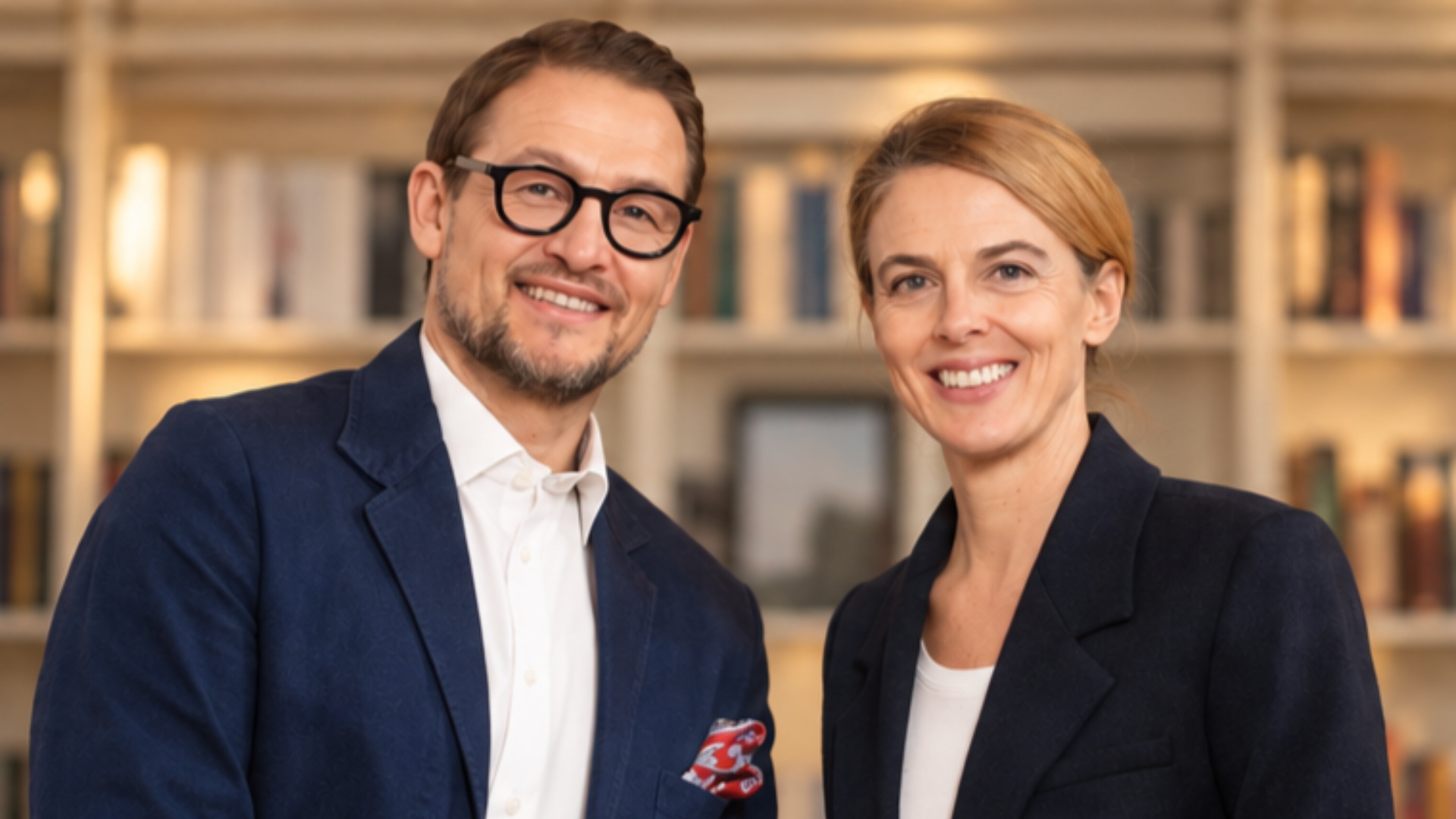
MCSC Group is pleased to welcome Hahn & Loewe as our newest partner. The Munich- and Aix-en-Provence-based boutique consultancy specialises in leadership and organisational development, working across Europe with entrepreneurs, executives and teams navigating transformation. Where MCSC structures the outer architecture of a career, a business or a family’s assets, Hahn & Loewe works on the inner side — clarity, identity, and the ability to lead oneself and others through change. In this conversation, co-founders Alexander Hahn and Svenja Op gen Oorth share how they work, what draws people to them, and why they believe this partnership can make transitions feel less like a break and more like a new chapter.
About Hahn & Loewe
Hahn & Loewe is a boutique consultancy for leadership and organisational development, based in Munich and Aix-en-Provence and working across Europe. Co-founders Alexander Hahn and Svenja Op gen Oorth combine more than 50 years of experience in management consulting, communications and coaching. Their approach is systemic, strengths-based and co-creative, drawing on a toolbox that ranges from NeuroLeadership, business constellations and organisational design to mediation and coaching methods. Strategies work when the people carrying them are ready — so they work on both at once.
Alexander Hahn, Co-Founder Former strategy consultant turned systemic sparring partner, who helps leaders turn clarity into momentum.
Alexander brings more than 25 years of international management consulting. He worked with Accenture, Arthur D. Little, PwC Consulting, IBM Consulting and SAP Ariba, where he guided organisations through strategic, commercial and procurement transformations. That background gives him an instinct for how strategies are built — and a sharp eye for where they tend to get stuck: in the people and the dynamics between them.
Today, he works at the point where business and human development meet. He is a certified trainer and coach (dvct, Gallup CliftonStrengths) and a mental coach. He also designs organisations and business models, grounding his work in an applied NeuroLeadership approach. At Hahn & Loewe, he works as executive sparring partner, coach and facilitator for senior leaders and leadership teams, with a particular focus on commercial and executive leadership in the German-French space.
People experience Alexander as energising and direct — a host who creates the space where real conversations happen and turns insight into momentum. He works in German and English, with a basic knowledge of French.
Svenja Op gen Oorth, Co-Founder Communications entrepreneur and systemic coach, who helps people and teams see what’s really going on, and what’s possible next.
Svenja has spent 25 years at the intersection of communication, leadership and human development. A lawyer by training, she became a PR strategist and founded her first company, Eloquenza PR, in 2003. Most recently, she built up the German business of an international communications agency. Along the way, she has lectured at Steinbeis University Berlin and was part of the faculty at Competence on Top.
Today, she accompanies executives, teams and entrepreneurs through transitions — as a certified systemic coach (dvct), mental coach, change manager, organisational development practitioner and NeuroLeadership practitioner. Her toolbox also includes strengths-based development, the MKR/MFL® methodology, psychological safety and constellation work. She designs formats that go beneath the surface: where patterns become visible, and where people find their own answers rather than borrowed ones.
People experience Svenja as a clear-sighted architect of change — conceptually deep, creative, and warm without being soft. She works natively in German and English, with a sound understanding of French to accompany that.
— For someone discovering Hahn & Loewe for the first time, how would you describe what you actually do?
— We help leaders, teams and organisations find clarity when things are moving fast, and turn that clarity into action. We work as strategy consultants and as systemic sparring partners at the same time. In practice, a strategy only works if the people carrying it are ready for it. So we work on both sides: the inner readiness of the people and the outer structures of the organisation.
The problems we’re called in for vary. Some are leadership teams that have lost alignment. Some are executives stepping into bigger roles, or making hard decisions under pressure. Others are organisations going through transformation, including AI, and whole systems that have simply become tired. One particular strength is reading systems — seeing where energy flows, where it’s stuck, and why. And we bring the tools to enable the flow: systemic coaching, NeuroLeadership, strengths-based work with Gallup CliftonStrengths, organisational design, mediation, consulting, workshops and constellation work. What connects them is one stance: we don’t fix people. We create the conditions in which they, and their organisations, can move again.
— How did you initially come up with the idea to create the company? What inspired you?
— Hahn & Loewe grew out of a combination we realised was rare. Alexander brings more than 25 years of management consulting, and Svenja brings 25 years in communications consulting and entrepreneurship. Over the years, both of us added training in systemic coaching, NeuroLeadership and strengths-based development. Together, that adds up to something people and organisations need today.
We kept seeing the same pattern. People are flooded with information. Methods that used to work don’t work anymore. Individuals and whole organisations are tired and unsure where to put their energy. Our own development taught us something simple: clarity comes back more easily when you look at a person, or a company, as a system rather than as a set of isolated problems. We wanted to bring exactly that to the market.
For me, Svenja, it was also a very personal step. I founded my first company at 29, and I love working on my own terms — shaping things, carrying full responsibility, leading, and passing on what I know. At Hahn & Loewe, we both get that freedom and the chance to create real impact. Every organisation and every person we work with also brings fresh inspiration back into our own system.
— Who usually comes to you for support?
— A bit of everything. We work with entrepreneurs and with employed executives, with whole teams and one-to-one. What they have in common is that they are in transformation, in the middle of reshaping something.
Some come to us exhausted and unsure of the next step. Others are full of energy and want someone at their side to help them get that energy onto the road. So it’s companies, teams and individuals in crisis — but just as often, people in situations full of opportunity.
— What does a typical situation look like when someone contacts you?
— Hard to say, as it differs from case to case. But what most of our clients share is an insight: they know they will move faster and further with support.
It’s the same in every discipline: top athletes have coaches, and the best performers seek outside perspective and expertise precisely because they want to keep getting better. Our clients recognise that some situations call for an outside view — someone who can shift perspective and bring fresh eyes. They also want a broad range of methods, so the situation can actually change rather than simply be analysed.
— How do you decide what a particular client actually needs?
— We start with a conversation, and in that conversation our aim is to understand the system: not only the person or the problem in front of us, but the wider web they are part of. We listen to what is being said, and to what the system itself is telling us — the people involved, the relationships, the pressures from outside. From that, we form hypotheses rather than diagnoses, and we test them together with the client.
Then we move to create the ideal format. Sometimes that is a one-to-one sparring for a leader carrying too much alone. Sometimes a leadership team needs a room where the real conversations can finally happen. And sometimes the answer is a constellation, which makes an invisible dynamic visible in a single session. Every time, it’s bespoke and tailored for the best possible outcome. The method serves the situation, never the other way around.
— What are some of the challenges you see most often among entrepreneurs and executives today?
— Four stand out.
The first is pressure. Many leaders absorb the pressure of the whole system, and that leaves little space to actually lead through it.
The second is decision fatigue. There are more options, more information and more speed than ever, and the brain under that kind of load narrows exactly when it needs to widen.
The third is role clarity. With transformation, and AI in particular, the question “what is my role now?” has become very real — for individuals and for whole teams.
On top of that, as the fourth, comes the pressure to implement AI fast, often in the hope that it will solve problems on its own. But if the foundation isn’t set — with clear roles, working processes and trust — AI doesn’t help. Adding tools blindly tends to amplify the confusion rather than resolve it.
Underneath all four, we often find the same thing: strategies that are sound on paper but don’t land, because the people who need to carry them aren’t ready yet. That gap is where we work.
— How different is your approach with one executive compared to an entire team?
— Our stance is the same. The field is different.
With one executive, we go deep. We look at patterns, strengths, identity, and how this person shows up in their system. With a team, the focus shifts to what happens between people: relationships, trust, unspoken rules, shared language, and whether it feels safe to say what needs saying.
The two often belong together. When a leader changes, the team around them changes too. And a team that changes gives each individual new room to grow. That’s why many of our programmes combine one-to-one coaching with team formats.
— Why is personal development such an important part of sustainable change within a company?
— Because organisations don’t change; people do. And then the organisation follows. A new structure or strategy is only as strong as the people who have to live it on a Monday morning.
At the same time, we’re careful not to put the whole burden on the individual. Much of what people do is shaped by the system around them. So we work on both: we strengthen the person, and we look at the system that person is part of. Our guiding principle puts it simply: “I am free to be myself. That is how others grow.” Leaders who have found clarity and presence for themselves change the climate around them, often more than any programme could.
— Why did you feel that a partnership with MCSC made sense for Hahn & Loewe?
— The way we see it, MCSC and Hahn & Loewe look at the same clients from two complementary angles.
MCSC works at the crossroads of sport, entertainment and private investment, advising athletes, clubs, investors and families on structuring their assets, careers and transitions. That covers the outer architecture of a life or a business. We work on the inner side: clarity, identity, and the ability to lead oneself and others through change.
Every transition has both dimensions. A contract, a relocation or an exit can be perfectly structured and still feel like losing ground if the person hasn’t found their new footing. We also share a belief: the best support comes from bringing the right people together, across countries and disciplines, rather than from one expert with one answer.
— Where do you see the strongest potential for collaboration?
— Wherever a structural change meets a human one. Four situations come to mind straight away:
Athletes after their career, bringing decades of discipline, focus and resilience into a new arena, and discovering who they want to become beyond the sport.
Entrepreneurs in succession or exit, where the business question is often easier than the personal one: who am I now, with everything this experience has given me, and how do I want to shape the road ahead?
International families and the next generation, facing roles, expectations and decisions that span countries and generations.
Leadership teams in clubs and companies that MCSC advises, when growth, investment or restructuring asks something new of the people at the top.
In each of these, MCSC brings the structure and we bring the clarity. The combination can make a transition feel less like a break and more like a chapter.
— What would you like this partnership to achieve within a year?
— A year from now, we’d like to look back on a handful of clients whom we supported together and who say the combination made a real difference — that they felt accompanied as whole people, not only as cases.
We’d also like to have developed a shared language and perhaps one joint format for transitions that neither of us could offer alone.
For our two organisations, success means trust that has grown through real work, recommendations flowing naturally in both directions, and each of us having learned something from the other’s world. If both our clients and our teams feel that 1 + 1 turned out to be more than 2, the partnership will have done what it should.